
table of content
- The Challenges Modern Sales Teams Face Today
- Delayed Lead Response
- Overloaded Sales Representatives
- Inconsistent Lead Qualification
- Scaling Pains
- The Cost of Inaction
- What Is a Conversational AI Sales
- How Conversational AI Sales Agents Work
- Step 1 — The Prospect Initiates a Conversation
- Step 2 — The AI Understands Intent
- Step 3 — The AI Provides Contextual Responses
- Step 4 — The AI Qualifies the Lead
- Step 5 — Handoff or Conversion
- Key Benefits of Conversational AI for Sales Teams
- 24/7 Lead Engagement
- Faster Lead Qualification
- Higher Conversion Rates
- Reduced Manual Workload
- Improved Sales Productivity
- Consistent Brand Experience
- Real-World Use Cases for Conversational AI Sales Agents
- SaaS — Automated Lead Qualification
- E-commerce — Personalized Product Recommendations
- Real Estate — Inquiry Automation
- EdTech — Admissions Support
- Travel — Booking Assistance
- Industries Leveraging Conversational AI Sales Agents
- The Future of AI-Driven Sales Automation
- AI Voice Agents
- Autonomous AI Sales Workflows
- Chatbots as a Primary Channel
- AI-Driven CRM Automation
- Deeper Human-AI Collaboration
- Conclusion


How Conversational AI Sales Agents Are Transforming Modern Sales Teams
Last Tuesday, someone ready to buy visited your website at 11 PM. They checked the pricing page, had a question, and left because nobody was there to help him. You showed up the next morning, but they already gone with someone else.
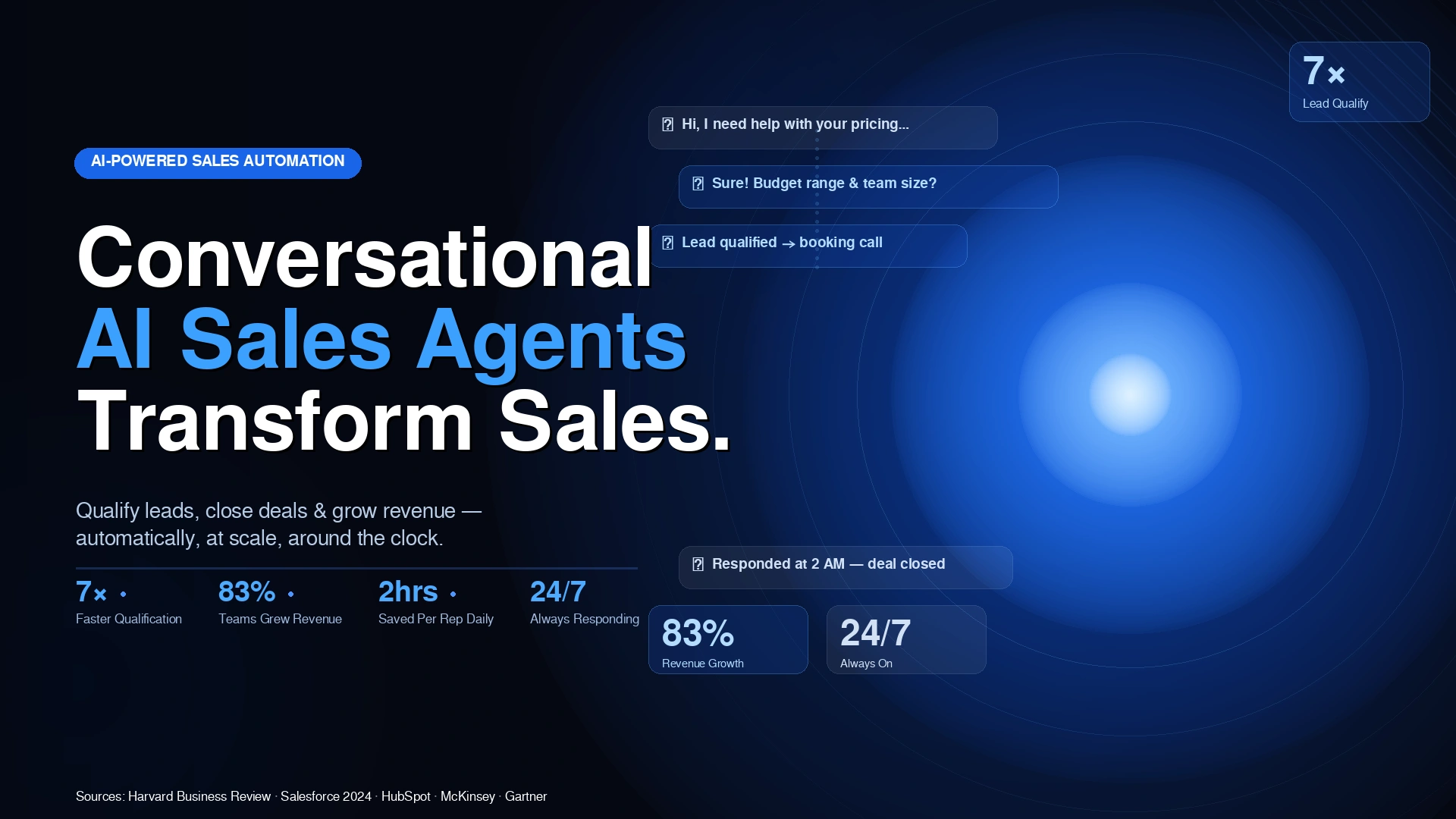
And this happens all the time. HBR studied 1.25 million sales leads. Companies that responded within an hour were 7x more likely to qualify a prospect. , but still some businesses take hours. Some take days. Every hour of silence is revenue drop.
This is what conversational AI sales were built for. They sit on your website, pick up the phone, answer WhatsApp messages, and whatever channel your buyer prefers and they do it at 2 AM without complaining. This is no longer experimental; companies are using it right now and it is working fine.
The Challenges Modern Sales Teams Face Today
But first, what is broken? Sales teams are drowning, and the tools they have been using were not built for this.
Delayed Lead Response
Speed-to-lead is the biggest factor in conversation. Most companies are terrible at it. HBR found only 37% of companies respond within an hour, That means almost two-thirds of businesses are losing buyers just because they are slow. That is the whole reason. Someone fills out your form, and if they do not hear back in a few minutes, they are already Googling your competitor.
Executive Insight
Companies that respond to a web lead within 1 hour are nearly 7× more likely to qualify it than those who wait 2+ hours. Yet only 37% of companies hit that benchmark — leaving the majority of leads underserved.
Source: Harvard Business Review — The Short Life of Online Sales Leads
Overloaded Sales Representatives
Sales reps spend a staggering amount of their time on non-selling activities. HubSpot's 2024 State of Sales report found that salespeople spend only about two hours a day actually selling — with at least one hour per day consumed by manual and administrative tasks. This leaves precious little time for the high-value conversations that close deals.
Inconsistent Lead Qualification
Without a standardized process, lead qualification becomes subjective and inconsistent. Some reps ask the right discovery questions; others skip steps entirely. The result is a pipeline full of poorly qualified opportunities that waste time and distort forecasts.
Scaling Pains
Hiring more sales reps to handle volume is expensive and slow. Training takes months. Yet demand fluctuates, a viral campaign or product launch can bring a surge of inbound interest that a fixed team simply cannot absorb without dropping balls.
The Cost of Inaction
Companies that fail to adopt AI sales automation risk losing high-intent leads to faster, AI-powered competitors — especially as buyer expectations for instant, personalized responses continue to rise.
What Is a Conversational AI Sales Agent?
A Conversational AI Sales Agent is a intelligent software system designed to engage prospects and customers through natural, human-like dialogue, automatically, at scale, and around the clock.
Unlike a basic rule-based chatbot that follows a rigid script, a modern AI sales assistant uses natural language processing (NLP) and machine learning to understand intent and respond contextually. Adoption has surged: Salesforce's 2024 State of Sales report found that 81% of sales teams are either experimenting with or have fully implemented AI and the results are measurable. Teams using AI are pulling ahead of those that are not.
These agents can operate across multiple channels:
- Website live chat and chat widgets
- Messaging platforms such as WhatsApp, Facebook Messenger, and SMS
- Email-based conversational workflows
- Voice assistants and phone-based AI agents
- CRM-embedded chat interfaces
83% of AI Sales Teams Grew Revenue
83% of sales teams using AI reported revenue growth last year — compared to just 66% of teams without AI. That's a 17-point advantage that compounds over time.
Source: Salesforce — State of Sales Report, 2024
The goal of a Conversational AI Sales Agent is not to replace human salespeople, it is to handle the repetitive, high-volume, top-of-funnel interactions so that human reps can focus on closing.
How Conversational AI Sales Agents Work
Understanding the high-level workflow helps business leaders see how AI lead qualification automation fits into their existing sales process.
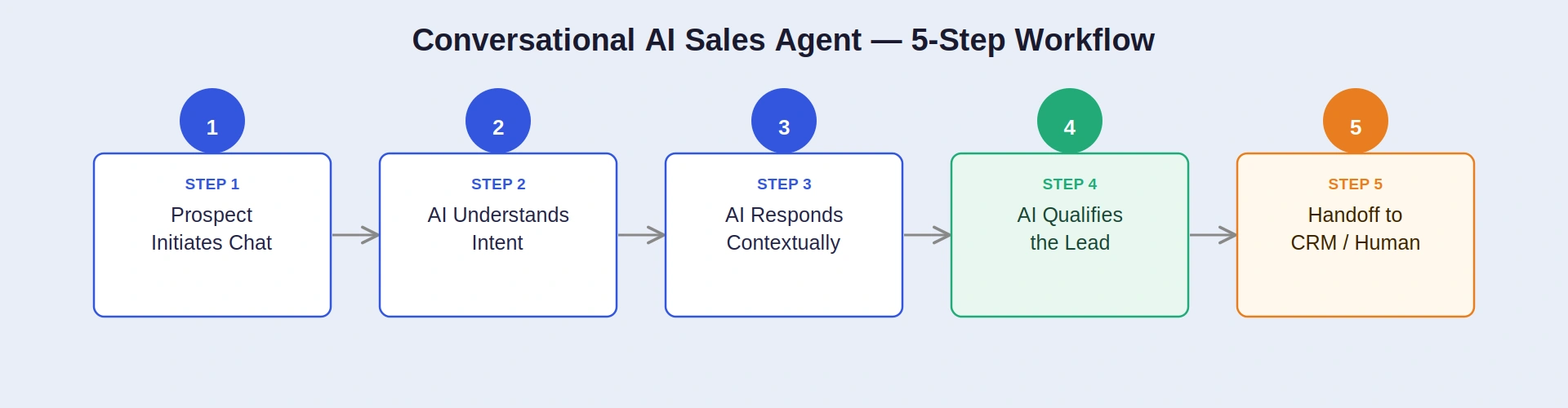
Step 1: The Prospect Initiates a Conversation
A visitor arrives on your website, opens a chat widget, sends a WhatsApp message, or calls a phone number powered by an AI voice agent. The interaction begins on the prospect's terms, on their preferred channel, at any time of day or night.
Step 2: The AI Understands Intent
The AI sales assistant analyzes the incoming message, identifies the topic, and determines what the prospect is trying to accomplish. Natural language understanding interprets nuance, context, and phrasing the way a human agent would without the delay.
Step 3: The AI Provides Contextual Responses
The AI delivers relevant, personalized responses drawing from product knowledge bases, FAQs, and CRM history. Gartner predicts that by 2028, 80% of customer service organizations will be applying generative AI in some form to improve agent productivity and customer experience a clear signal that businesses are investing in AI-powered conversation at scale.
Step 4: The AI Qualifies the Lead
The agent asks targeted discovery questions budget range, decision timeline, company size, use case and maps the answers against your ideal customer profile (ICP). This AI lead qualification automation ensures that only genuinely qualified leads move forward in your pipeline.
Step 5: Handoff or Conversion
Qualified leads are routed instantly to the right human sales rep, with a full conversation summary and qualification data pre-loaded into the CRM. For transactional interactions, the AI can close the loop entirely without any human involvement.
Why This Matters
Every step in this workflow happens in real time, 24 hours a day, without human input. That means your sales funnel never sleeps — and high-intent leads never fall through the cracks at 2 AM on a Sunday.
Key Benefits of Conversational AI for Sales Teams
Businesses that deploy Conversational AI Sales Agents consistently report measurable improvements across their key sales metrics. Here are the six most impactful benefits.
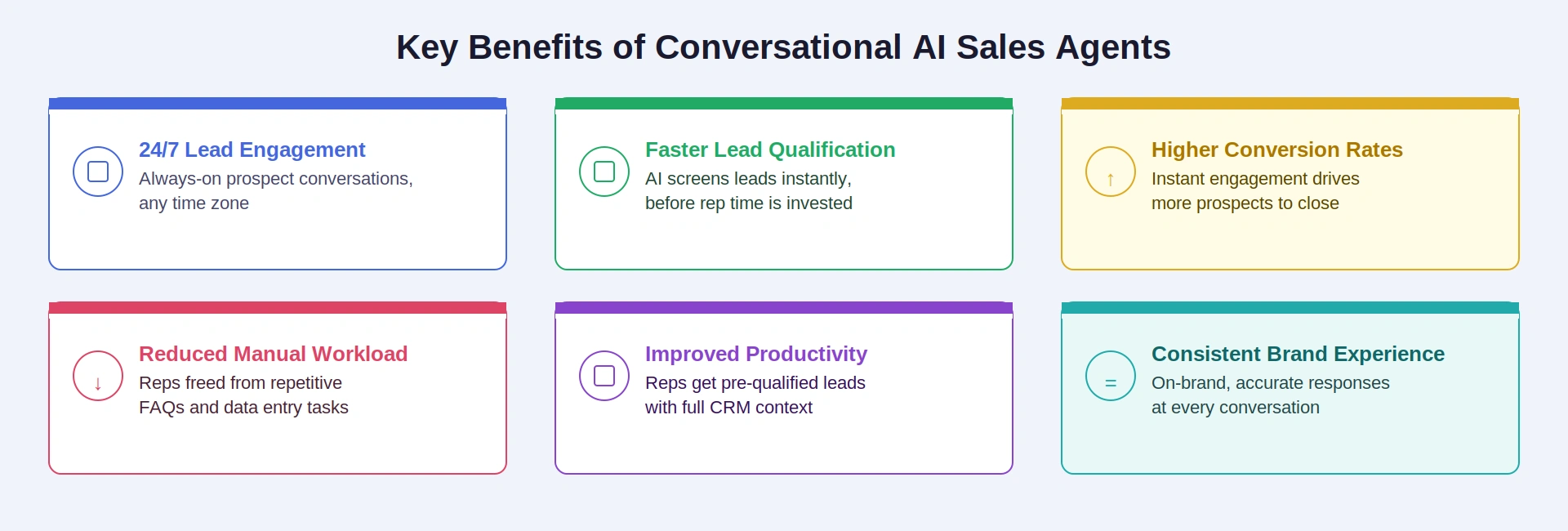
24/7 Lead Engagement
Your AI sales assistant works every hour of every day including weekends, holidays, and off-hours when human reps are unavailable. High-intent prospects get an immediate response regardless of when they reach out, dramatically reducing lead drop-off from out-of-hours visits that previously went unanswered.
Faster Lead Qualification
AI lead qualification automation accelerates the process of identifying your best opportunities. HubSpot data shows that using AI to qualify leads saves sales professionals 1–2 hours per day time that compounds across a full team into a significant productivity gain week over week.
Higher Conversion Rates
Instant responses, personalized conversations, and consistent qualification logic all contribute to improved conversion rates. Salesforce found that 83% of sales teams using AI grew revenue, versus 66% of teams without AI a 17-percentage-point advantage that reflects what consistent, fast, intelligent engagement can achieve at scale.
Reduced Manual Workload
By handling repetitive queries, FAQ responses, scheduling, and data entry, conversational AI for sales frees your reps to focus on relationship-building and closing. HubSpot's 2024 State of Sales report found that AI saves salespeople an average of two hours per day — with 81% saying AI helps them spend less time on manual tasks.
2 Hours Saved Per Rep Per Day
AI saves salespeople an average of 2 hours per day. 81% of sales professionals say AI helps them spend less time on manual tasks — giving the time back for actual selling.
Source: HubSpot — 2024 State of Sales Report
Improved Sales Productivity
When reps receive pre-qualified leads with full conversation context already in the CRM, they spend less time on discovery and more time on persuasion. 70% of sales professionals using AI for prospect outreach report getting a higher response rate making every hour of selling time more effective.
Consistent Brand Experience
Every prospect receives the same high-quality, on-brand interaction regardless of the time of day or the volume of simultaneous conversations. According to Salesforce, sales teams using AI are 1.3 times more likely to see a revenue increase consistency at scale is a genuine competitive advantage, not just a nice-to-have.
Real-World Use Cases for Conversational AI Sales Agents
Conversational AI Sales Agents adapt to the unique sales motions of diverse industries. Here are five real-world examples of how businesses are deploying them today.
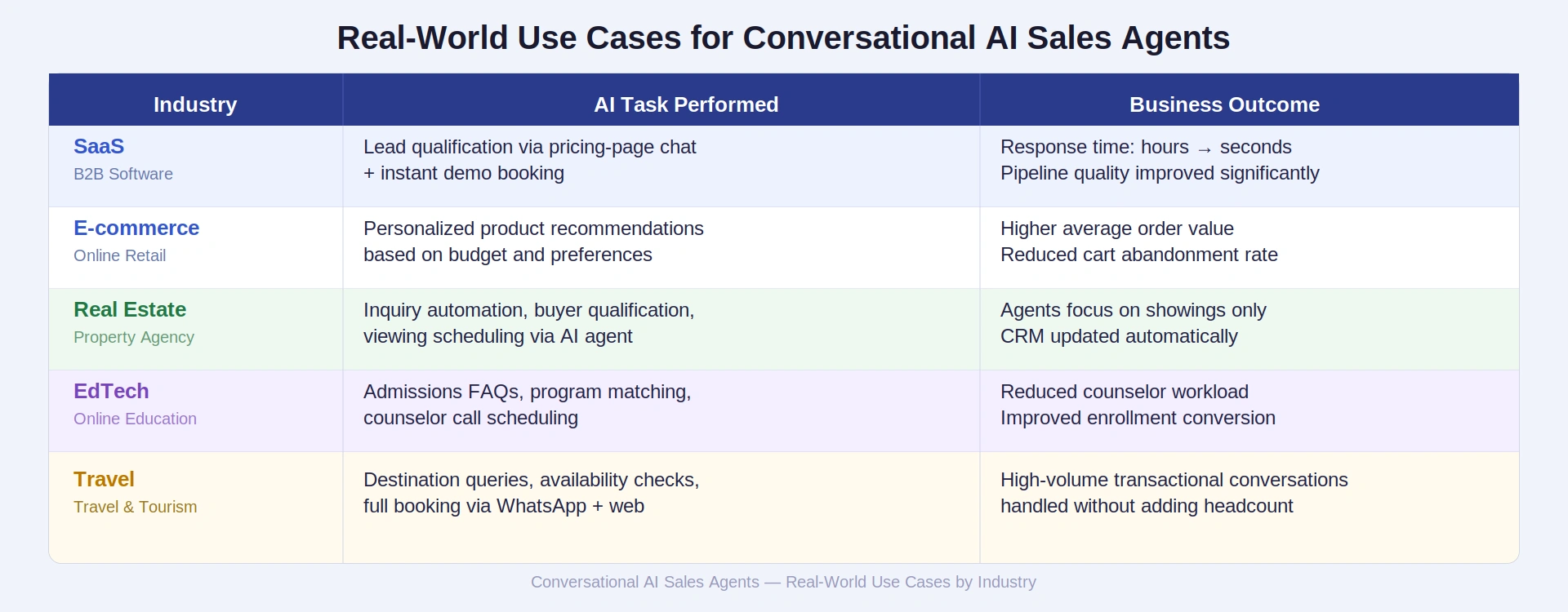
SaaS: Automated Lead Qualification
A B2B SaaS company deploys an AI chatbot for sales on its pricing page. The AI engages high-intent visitors, asks qualification questions, scores the lead, and books a call with the right account executive, all in seconds. HubSpot reports that 70% of sales professionals using AI for outreach say it helps them achieve a higher response rate making the AI agent a direct pipeline driver, not just a support tool.
E-commerce: Personalized Product Recommendations
An online retailer uses a conversational AI agent to guide shoppers through product selection. The AI asks about preferences, budget, and use case, then recommends the best-fit products — functioning as a virtual sales associate that increases average order value and reduces cart abandonment at any hour.
Real Estate: Inquiry Automation
A real estate agency automates its inbound inquiry process with an AI sales assistant that answers questions about property listings, collects buyer qualification details, schedules property viewings, and updates the CRM all without an agent lifting a finger. Human agents focus exclusively on showings and negotiations.
EdTech: Admissions Support
An online education platform uses conversational AI to guide prospective students through the admissions process answering FAQs about course content and fees, helping applicants identify the right programme, and booking consultation calls with advisors reducing workload while improving enrolment rates.
Travel — Booking Assistance
A travel company deploys an AI agent across WhatsApp and its website to assist customers in planning and booking trips. The agent handles destination queries, checks availability, presents package options, and completes bookings — handling high-volume transactional conversations at scale without adding headcount.
Industries Leveraging Conversational AI Sales Agents
AI sales automation is gaining traction broadly across sectors. McKinsey's 2024 State of AI survey found that 78% of organizations now use AI in at least one business function, up from 55% a year earlier — proving that AI adoption has firmly crossed the mainstream threshold. Here is a snapshot of the industries leading the way:
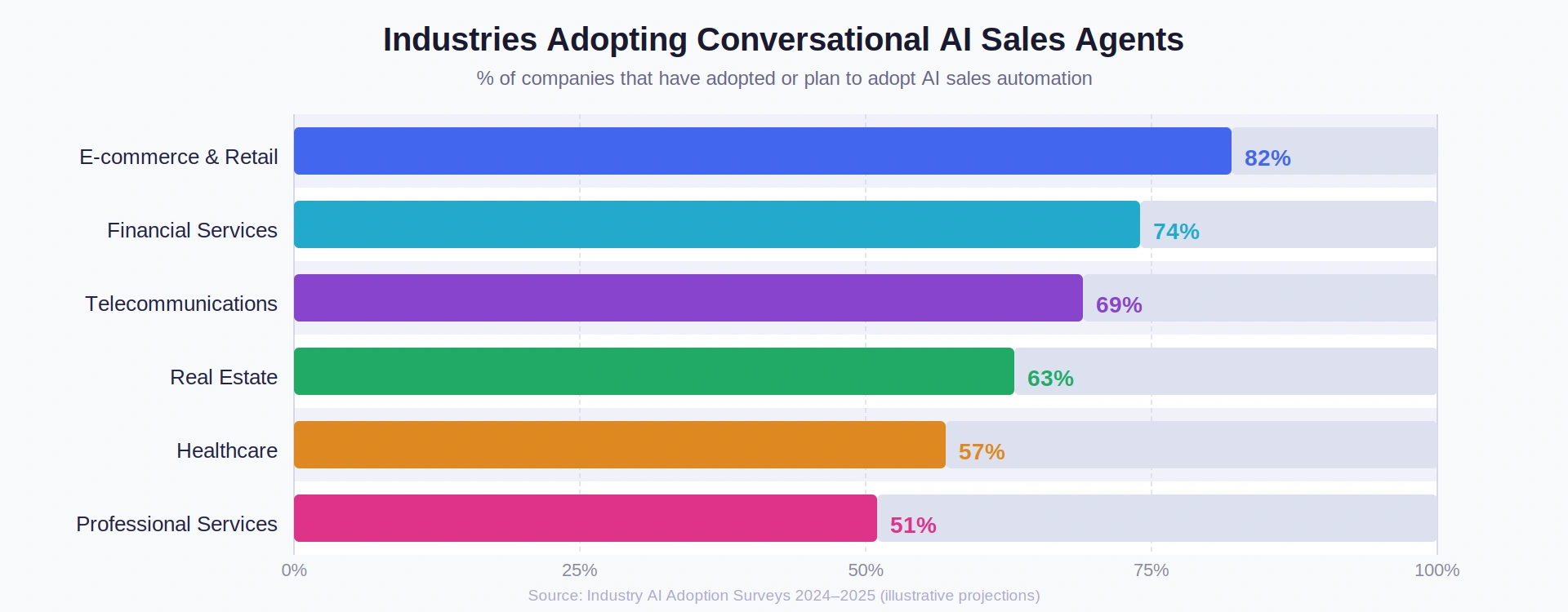
- Financial Services: Banks and insurance companies use AI agents to qualify loan applicants, cross-sell products, and answer regulatory FAQs at scale.
- Healthcare: Medical providers use conversational AI to handle appointment scheduling, insurance verification, and patient intake which free clinical staff for care delivery.
- Retail and E-commerce: From product discovery to post-purchase support, AI agents power the full customer journey in digital retail.
- Telecommunications: Telecom providers deploy AI chatbots for sales to guide customers through plan upgrades and reduce churn.
- Automotive: Dealerships use AI agents to engage website visitors, answer vehicle questions, and book test drives without tying up human staff.
- Professional Services: Consulting and legal firms use AI to qualify inbound interest and capture lead data before human experts engage.
78% of Organizations Now Use AI
78% of organizations use AI in at least one business function — up from 55% the year before. Marketing and sales is consistently one of the top two functions where AI is deployed.
Source: McKinsey — The State of AI: How Organizations Are Rewiring to Capture Value, 2024
Across all these industries, the common thread is the same: high volumes of repetitive, time-sensitive conversations that AI handles better, faster, and more cost-effectively than human teams alone.
The Future of AI-Driven Sales Automation
Conversational AI for sales is evolving rapidly, and the capabilities available today are only the beginning. Here is what the next few years look like for AI sales automation.
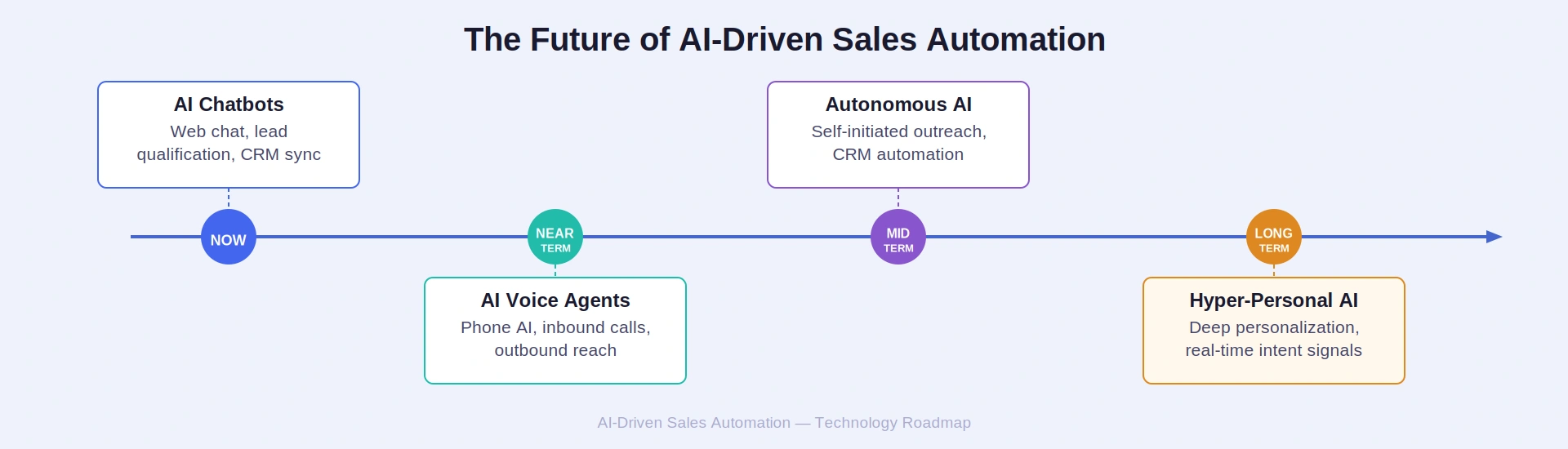
AI Voice Agents
Natural-language voice AI is maturing quickly. AI voice agents can now conduct phone-based sales conversations, handle inbound calls, qualify leads verbally, and make outbound prospecting calls with quality increasingly indistinguishable from a human representative.
Autonomous AI Sales Workflows
The next generation of AI sales automation goes beyond reactive conversations. Gartner predicts that by 2029, agentic AI will autonomously resolve 80% of common customer service issues without human intervention, reducing operational costs by 30% a future in which AI takes the initiative, not just responds to it.
Chatbots as a Primary Channel
The shift toward AI-first engagement is well underway. Gartner predicts that by 2027, chatbots will become the primary customer service channel for roughly a quarter of all organizations a trend that will accelerate as AI quality improves and buyer preferences continue to shift toward instant, self-serve interactions.
AI-Driven CRM Automation
As AI agents become more deeply integrated with CRM platforms, they will automatically update contact records, log every touchpoint, trigger follow-up sequences, and generate pipeline forecasts — eliminating manual data entry entirely.
Deeper Human-AI Collaboration
Rather than replacing salespeople, the future points toward a model where AI handles everything up to the point of complex negotiation and relationship building. HubSpot's research shows that 78% of sales professionals say AI helps them be more efficient in their role proving that the competitive advantage goes to those who work with AI, not around it.
78% of Organizations Now Use AI
78% of organizations use AI in at least one business function — up from 55% the year before. Marketing and sales is consistently one of the top two functions where AI is deployed.
Source: McKinsey — The State of AI: How Organizations Are Rewiring to Capture Value, 2024
Conclusion
Conversational AI Sales Agents represent one of the most significant shifts in how businesses attract, engage, and convert customers. By combining the speed and scale of automation with the personalization of natural conversation, they solve many of the most persistent challenges facing modern sales teams' slow response times, inconsistent qualification, rep burnout, and the inability to engage leads around the clock.
The data from the world's most credible research organizations tells a clear story: a 7x improvement in lead qualification from responding within one hour; 83% of AI-powered sales teams growing revenue versus just 66% without it; and 78% of organizations now deploying AI in their business. These are outcomes being measured today by businesses that acted early not future projections.
The question for business leaders is no longer whether to adopt conversational AI for sales. It is how quickly you can get started before your competition does.
Ready to Transform Your Sales Process?
Explore how a Conversational AI Sales Agent can help your team qualify more leads, respond faster, and close more deals — without adding headcount. The best time to start is now.
FAQs
Can conversational AI sales agents replace human sales reps?
No , AI sales agents are designed to work alongside human reps, not replace them. They handle high-volume, repetitive top-of-funnel tasks such as instant lead response, lead qualification, and FAQ handling, using natural language processing (NLP) and machine learning to understand buyer intent. This frees your human sales team to focus on complex negotiations, relationship-building, and closing deals. Think of AI for sales as a force-multiplier: Salesforce found that 83% of sales teams using AI sales tools grew their revenue, while HubSpot reports reps save up to 2 hours per day — time redirected into high-value selling activities.
Do customers know they are talking to AI?
Transparency depends on how a business configures its AI sales agent Modern AI sales automation tools powered by natural language processing are conversational and human-like in tone, but best practice and increasingly, regulation encourages businesses to disclose when a customer is interacting with an AI. Many companies introduce their AI sales agent with a name and clear identity (e.g., 'Hi, I'm Aria, your AI assistant'). When deployed ethically, customers appreciate the instant, 24/7 availability. Gartner predicts chatbots will become the primary customer service channel for 25% of organisations by 2027, signalling growing customer acceptance of AI-powered conversations.
What kind of tasks can an AI sales agent handle?
AI sales agents can handle a wide range of tasks across the sales funnel, including: 24/7 lead engagement across website chat, WhatsApp, SMS, and email; AI lead qualification by asking discovery questions (budget, timeline, company size) and scoring prospects against your ICP; booking meetings and syncing calendars; answering product and pricing FAQs; personalised product recommendations (especially in e-commerce); CRM data entry and contact record updates; and outbound prospecting follow-ups. By combining NLP (natural language processing) and machine learning, modern AI sales tools understand context and intent not just keywords enabling genuinely helpful, human-like conversations at scale.
How long does it take to implement a conversational AI solution?
Implementation timelines for AI sales automation vary by platform and complexity. A basic AI sales agent deployed on a website or WhatsApp channel can go live in as little as 1–2 weeks. More sophisticated implementations with deep CRM integrations, custom AI sales workflows, multi-channel deployment, and bespoke natural language processing training typically take 4–12 weeks. McKinsey's 2024 State of AI report found 78% of organisations now use AI in at least one business function, with marketing and sales among the top two suggesting the tooling and best practices for fast deployment are increasingly mature and accessible regardless of company size.
Is conversational AI only useful for large enterprises?
Not at all. While large enterprises were early adopters of AI sales tools, today's AI sales automation platforms are built for businesses of all sizes. SMBs and startups benefit enormously from AI for sales especially the ability to respond to leads instantly without hiring additional staff. A small team using an AI sales agent can compete with larger rivals on speed-to-lead, which Harvard Business Review found is the single biggest driver of lead qualification (companies responding within 1 hour are 7× more likely to qualify a prospect). Whether you are a 5-person SaaS startup or a 500-person enterprise, conversational AI and machine learning-powered sales agents level the playing field.